Rwanda

Overview

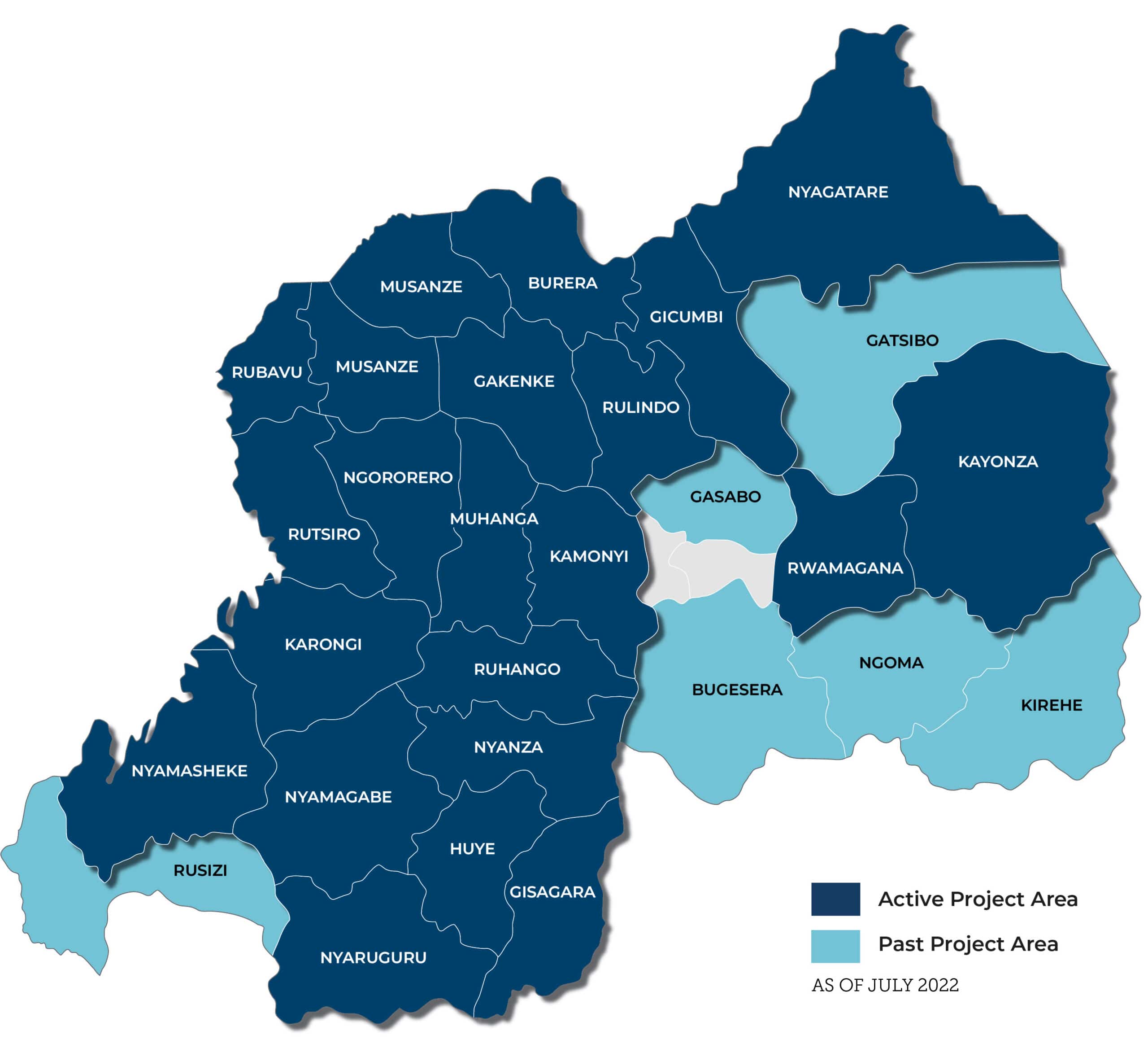
Map of our projects in Rwanda

Since 2000, Heifer International has worked alongside farming communities in Rwanda to end hunger and poverty while caring for the Earth. Across 27 districts, we support smallholder farmers, especially women and young people, to build resilient livelihoods, grow profitable businesses, and earn a sustainable living income. 

Our work focuses on dairy, small livestock, and horticulture, connecting improved production with better nutrition, reliable markets, and employment opportunities. We bring together farmers, government institutions, businesses, financial service providers and innovators to address the challenges that hold rural enterprises back, from limited access to quality inputs and affordable finance to climate pressures and gaps in market access. Since we began working in Rwanda, our projects have reached 1,944,692 households, an estimated 7.8 million people based on an average household size of four, including 36,120 households newly reached in fiscal year 2026. 

Community ownership is at the heart of our approach. Through the Values-Based Holistic Community Development (VBHCD) model, we strengthen self-reliance, collective action, and the capacity of farmer organizations to manage resources and businesses. The Passing on the Gift (PoG) model enables participating families to share productive assets, knowledge, and skills with others, extending benefits throughout their communities. 

Building on this foundation, our projects strengthen the services and market relationships farmers need to succeed. Support spans animal health, improved breeds and seeds, feed and fodder, water access, climate-smart farming, mechanization and post-harvest management. Cooperatives and farmer-led enterprises are helped to access markets, finance and insurance services, add value to their products and build stronger relationships with buyers. Through AYuTE Rwanda, young agritech entrepreneurs receive catalytic funding, mentorship, and business development support to advance solutions for smallholder farmers. 

The Rwanda Agribusiness Transformation Signature Program (2025–2035) guides this work, aiming to support 300,000 smallholder households by 2035, with women representing 55% and youth 30% of targeted participants. Aligned with Rwanda’s national transformation and agricultural development priorities, the program brings together local leadership and Heifer’s global expertise to build a more resilient, inclusive, and market-oriented food system. 

Together with our partners, we are helping farming households improve their income and food security, create opportunities for the next generation, and shape lasting change in rural communities. 

The Rwanda Signature Program

The Rwanda Agribusiness Transformation Signature Program (RWATSP) is Heifer International Rwanda’s ten-year program (2025–2035) for building a resilient, inclusive, and competitive agricultural sector. Focusing on dairy, small livestock, and horticulture, the program aims to enable 300,000 smallholder farming households to thrive by 2035, with participation targets of 55% women and 30% youth. 

The program addresses the barriers that limit farmers’ productivity and incomes: inadequate access to quality inputs, finance, and technologies; weak farmer organizations; high production costs; post-harvest losses; and limited market connections. Its ambition is to help farming families earn a sustainable living income while strengthening food and nutrition security, creating economic opportunities, and protecting the environment. 


Four priorities for lasting change

Stronger farmer organizations and enterprises

Strengthen self-help groups, cooperatives and micro, small and medium-sized enterprises through better leadership, governance, financial literacy and business management, enabling farmers to invest, negotiate and grow together.

Higher, more resilient productivity

Improve access to quality breeds and seeds, animal health and extension services, feed and fodder, water, and sustainable soil management. Promote climate-smart practices and technologies that increase production while safeguarding natural resources.

More profitable businesses and inclusive markets

Reduce post-harvest losses and production costs through improved handling, storage, processing, and energy-efficient technologies. Strengthen aggregation, value addition, and buyer relationships to help farmers access higher-value markets.

A stronger enabling environment

Support policy dialogue, institutional capacity, and coordination to encourage investment, improve agricultural services, and sustain inclusive growth.

Locally led and connected through partnerships 

RWATSP combines Heifer’s Values-Based Holistic Community Development approach with Market Systems Development. Communities shape priorities and strengthen collective action, while partnerships with government, businesses, financial institutions, research organizations, and service providers improve the systems farmers depend on. 

Women’s empowerment, youth entrepreneurship, climate resilience, digital innovation, and inclusive finance run across all interventions. The program promotes mechanization, digital advisory services, agricultural insurance, and tailored financing to help farmers and enterprises invest and manage risk. 

Investment and accountability 

The program has a projected budget of US$152.4 million, with a planned financing mix of 55% institutional donor funding, 25% Heifer contributions, and 20% farmer and private-sector contributions and investment. This collaborative model aims to mobilize resources and sustain results beyond individual projects. 

Aligned with Rwanda’s Vision 2050, the National Strategy for Transformation (NST2) and the Fifth Strategic Plan for Agriculture Transformation (PSTA 5), RWATSP will track changes in household incomes, productivity, enterprise performance, and resilience. Monitoring, evaluation, and regular learning will guide adaptation throughout implementation. 

By 2035, the program aims to leave stronger farmer-led businesses, more reliable markets and services, and farming communities equipped to sustain their own prosperity. 

Key Interventions 

Heifer International Rwanda supports smallholder farming families to build resilient livelihoods and profitable enterprises across dairy, small livestock, and horticulture. Our interventions combine community leadership with access to productive assets, knowledge, finance, technology, and markets. 

Strengthening Farmer Organizations 

We help farmers organize into self-help groups, cooperatives, and farmer-owned enterprises. Through Values-Based Holistic Community Development, we strengthen leadership, governance, financial literacy, and business management, enabling farmers to mobilize resources, make collective decisions, and negotiate better market opportunities. 

Improving Livestock and Crop Productivity 

We support farmers with quality livestock breeds and seeds, improved animal housing, animal health services, and practical training in sustainable production. Our work strengthens access to feed, fodder, water, and extension services to improve productivity, product quality, and household nutrition. 

Expanding Opportunity through Passing on the Gift 

Families share livestock offspring, knowledge, skills and other productive resources with additional households. This approach extends the benefits of our programs while strengthening solidarity, accountability and community ownership. 

Building Climate Resilience 

We promote climate-smart farming, rainwater harvesting, efficient water use, soil conservation, composting and sustainable manure management. These practices help farmers protect natural resources, manage climate risks, and sustain production through changing conditions. 

Advancing Mechanization and Digital Innovation 

We work with technology providers and young innovators to make agricultural tools and services more accessible. Mechanization hubs, pay-as-you-go tractor services, digital platforms and improved post-harvest technologies help farmers reduce labour demands, improve efficiency and grow their businesses. 

Linking Farmers to Better Markets 

We strengthen aggregation, product quality, storage, processing and value addition to reduce losses and improve returns. By connecting farmer organizations with buyers, processors and service providers, we help them participate more competitively in domestic, regional and export-oriented value chains. 

Expanding Access to Finance 

We strengthen savings groups and connect farmers and agribusinesses with financial institutions, insurance and tailored financing solutions. Financial literacy, business planning and investment support help farmers manage risk and secure the resources needed to expand their enterprises. 

Supporting Women and Youth 

We strengthen women’s leadership, participation in household decisions and access to economic opportunities. Through AYuTE Rwanda and wider enterprise development initiatives, we support young people with funding, business training and mentorship to develop agricultural innovations and create jobs. 

Strengthening Partnerships and Agricultural Services 

We convene partners including government, businesses, financial institutions, research organizations, and communities to address barriers across agricultural value chains. Policy dialogue, joint planning and evidence-based learning help improve services, encourage investment, and sustain results beyond individual projects. 

Strategic Value Chains

Heifer International Rwanda focuses on dairy, small livestock, and horticulture value chains with strong potential to improve nutrition, increase incomes, and create employment for women and young people. We work across production, services, processing, and markets to help smallholder farmers build profitable and resilient enterprises. 

Dairy

We support smallholder dairy farmers to improve livestock management, access quality breeds and animal health services, and secure reliable supplies of feed, fodder and water. Our work also strengthens farmer organizations, milk collection systems, access to finance, and market connections. Through the Rwanda Dairy Development Project Phase II (RDDP II) and Rwanda Dairy Market Systems (RDMS), we promote climate-smart production, mechanization, and commercially viable services that improve efficiency and profitability across the dairy sector. 

Horticulture

We support farmers to produce tomatoes, onions, garlic, carrots, French beans, and chili using climate-smart practices. Through Heifer’s contribution to the Promoting Smallholder Agro Export Competitiveness (PSAC) project, farmers access quality inputs, training in crop management and post-harvest handling, and support to organize production and connect with buyers. Our focus on domestic, regional, and export markets helps farmers reduce losses, meet quality requirements, and earn more from their produce. 

Across these value chains, we integrate inclusive finance, digital innovation, mechanization, and climate resilience, while strengthening women’s leadership and opportunities for youth employment and entrepreneurship. 

Small Ruminants

Small livestock give farming families opportunities to diversify income and improve household nutrition. Through the Partnership for Resilient and Inclusive Small Livestock Markets (PRISM), we combine productive animals with improved housing, training, veterinary services, breeding support, and access to feed and markets. Passing on the Gift® extends these benefits to additional households, while savings groups and stronger producer organizations help farmers invest and grow their enterprises. 

Featured Projects

Heifer International Rwanda works with farming communities, government, and private-sector partners to strengthen dairy, small livestock, and horticulture value chains while advancing youth-led agricultural innovation. These five initiatives help farmers improve productivity, access markets and finance, and build more resilient livelihoods. 

Downloads


Partners

Strong partnerships are central to our work and success in Rwanda. Together with government institutions, development partners, the private sector and local organizations, we support smallholder farmers to improve productivity, strengthen resilience and access opportunities for sustainable incomes. 

  • International Fund for Agricultural Development (IFAD): A key financing partner supporting inclusive rural development through investments in dairy, small livestock and agricultural value chains. 
  • Government of Rwanda: A strategic partner and co-financier, aligning our programs with national development priorities and supporting delivery through public institutions and local authorities. 
  • Ministry of Agriculture and Animal Resources (MINAGRI): Our principal government partner in the agriculture sector, providing policy leadership and coordination to advance sustainable production, stronger markets, and climate-resilient farming systems. 
  • Rwanda Agriculture and Animal Resources Development Board (RAB): Leads RDDP II and PRISM through its project implementation units, with Heifer serving as an implementing partner. 
  • National Agricultural Export Development Board (NAEB): Leads the PSAC project, through which Heifer supports horticulture households to reach domestic, regional and export markets. 
  • Hello Tractor: Technology partner for RDMS, providing the pay-as-you-go tractor platform that underpins the project’s mechanisation hubs and expands farmers’ access to affordable equipment. 
  • Local Government (Districts): Districts play an important role in supporting project implementation, facilitating coordination with local stakeholders, mobilizing communities, and ensuring alignment with local development priorities. 
  • Private-sector partners: Off-takers, input suppliers, agritech companies, and financial institutions that help farmers access markets, inputs, technology, and finance. 
  • Local civil society organizations: Community-based organizations that share Heifer’s mission and support implementation through their presence in communities. 
“Heifer’s support has not only provided us with livestock, but has also empowered our community. We have seen significant improvements in our income and nutrition, and the knowledge shared has truly transformed our lives.”

Jean Pierre, smallholder dairy farmer from Rwamiko Sector, Gicumbi District (original in Kinyarwanda)

Contact Heifer in Ethiopia

Partner with Heifer International Africa to scale proven solutions, build enabling environments, and invest in profitable agribusinesses that create lasting change for our smallholder farmers.


Social Media

Heifer's Facebook Pagelinkedin iconHeifer's Twitter/X Page

We Work Across Africa

(DRAFT CONTENT)