Rice
Closing national production deficits by boosting domestic yields, advancing mechanization, improving access to certified inputs, and linking producer clusters directly to commercial off-takers and processing hubs.


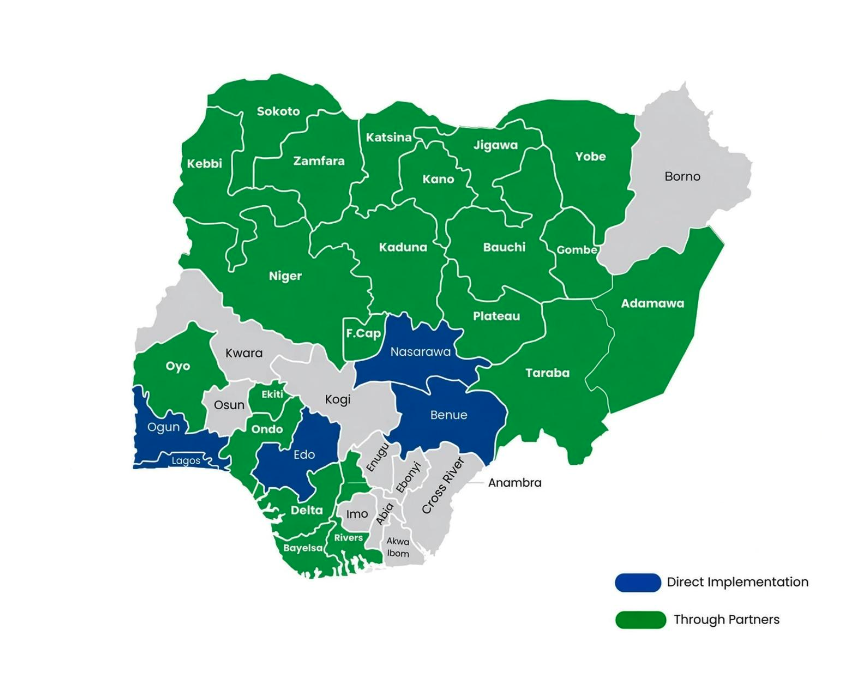
Agriculture is the backbone of the economy in Nigeria, providing sustenance, employment and income for millions. However, despite notable strides in improving productivity and food security in the early 2000s, economic growth has slowed in recent years and challenges such as climate change, inadequate infrastructure, inefficient supply chains and limited credit access persist, particularly for smallholder farmers. Although the country has abundant agricultural resources, including arable land and plentiful rainfall, local demand significantly outweighs local production, prompting a heavy reliance on food imports.
Additionally, the sluggish job market struggles to support the 3.5 million Nigerians who enter the workforce every year. The World Bank estimates nearly 39 percent of the population was living below the poverty line in 2023. Going forward, agriculture has an important role to play in Nigeria’s economic recovery and development. Future growth hinges on strengthened support for smallholder farmers that enables them to withstand extreme weather, access machinery, secure financing and optimize supply chains to increase profitability. This transformation is crucial as Nigeria faces the challenge of feeding and employing a rapidly growing population projected to reach 400 million by 2050.


Heifer Nigeria directs its programmatic interventions and catalytic investments into priority value chains that offer the greatest opportunities for income transformation, youth job creation, and import substitution.
Closing national production deficits by boosting domestic yields, advancing mechanization, improving access to certified inputs, and linking producer clusters directly to commercial off-takers and processing hubs.
Building decentralized production and aggregation networks, improving smallholder bio-security, streamlining reliable feed sourcing, and connecting producers to premium, structured urban markets.
Slashing acute post-harvest losses through cold chain aggregation, modern solar irrigation, good agricultural practices (GAP), and outgrower integration with industrial tomato processors.
Strengthening pastoral livelihoods and cooperative models around dairy production, developing clean milk aggregation infrastructure, and supporting sustainable livestock value chains.
Naija Unlock is Heifer’s signature program in Nigeria. It aims to unlock the country’s potential for food self-reliance by raising production to meet local demand while closing the living income gap for smallholder households by investing in target value chains, promoting import substitution, and leveraging innovation and emerging agricultural technologies to achieve impact at a transformational scale.
Scaled initiative supporting up to 1.2 million smallholder rice farmers with high-yield seeds, climate-smart farming techniques, digital agronomy, and structured commercial off-taking agreements.
Lease-to-own solar pumps over two years so farmers can irrigate beyond the rains. Supports rice and tomato systems and is linked to poultry production, and can cut fuel costs by up to 40 percent.
Flagship youth agritech innovation competition awarding catalytic grants and technical mentorship to early-stage startups deploying scalable technology across the agricultural value chain.
Dry-season cultivation, drip irrigation, pest management, and post-harvest preservation program connecting smallholders directly to industrial paste processors and major food distributors. Aims to support 200,000 smallholders to grow more tomatoes and cut post-harvest loss, using solar irrigation and storage, better agronomy, group management, and links to quality inputs and buyers.
Commercialization model strengthening smallholder poultry clusters with quality inputs, cooperative aggregation, brooding facilities, and steady off-take agreements. Supports 600,000 poultry farmers, with a focus on women and youth. Tackles feed cost, mortality, and weak animal-health services; expands processing and improved breeds; and uses financing and value-chain coordination for more stable incomes. Includes the Edo partnership with Amo Farm Sieberer Hatchery on a processing facility near farmers.
Smart tractor financing and mechanization-as-a-service model (partnering with innovators like Hello Tractor) to provide on-demand, affordable tillage and harvesting to rural farmers, leveraging a co-sharing and pay-as-you-go model so young entrepreneurs and smallholders can own or hire tractors without conventional collateral.
Cooperative development, milk collection center (MCC) establishment, cold-chain preservation, and feed improvement to boost daily yields and farmer revenues. Supports smallholder dairy farmers in Adamawa and Taraba to move toward settled, commercial systems: improved breeding and animal health, irrigated fodder, cooperatives, milk collection, and finance.


Heifer Nigeria delivers systemic impact through a multi-stakeholder ecosystem of public, private, and development finance institutions:
“Having identified one of the problems of smallholder poultry farmers in Edo, which is the lack of access to the market, the Edo State Government of Nigeria is happy to partner with Heifer Nigeria and other critical stakeholders to empower our farmers through linkages to improved [and] environmentally friendly poultry production practices and innovations, new market opportunities and innovative financing.”
Partner with Heifer International Africa to scale proven solutions, build enabling environments, and invest in profitable agribusinesses that create lasting change for our smallholder farmers.




(DRAFT CONTENT)
Did you know?
You can add multiple resources to this cart! Feel free to keep browsing, add more resources, and get all of your resources in one package. Easy!
Cart is empty
Success!
Please be patient while we send you to a confirmation page.
We are unable to process your request. Please try again, or view common solutions on our help page. You can also contact our Donor Services team at 855.9HUNGER (855.948.6437).
Success!
Please be patient while we send you to a confirmation page.
We are unable to process your request. Please try again, or view common solutions on our help page. You can also contact our Donor Services team at 855.9HUNGER (855.948.6437).
