Red Meat
Improved breeding, feeding, market systems for enhanced value and incomes.


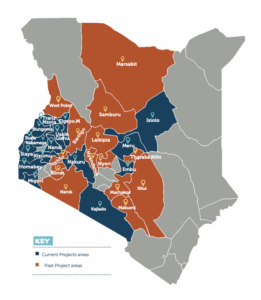
Kenya’s economy relies heavily on farming, but it faces many challenges. After recovering from the COVID-19 pandemic, the country was significantly impacted by the 2023 drought in the Horn of Africa, which left 4.4 million people facing severe food shortages and approximately 1.1 million women and children suffering from acute malnutrition.
Farming makes up more than one-third of Kenya’s gross domestic product and employs more than 70 percent of the rural population. However, problems such as low productivity, lack of access to finance and poor infrastructure make it hard for farmers to succeed. Animal diseases further compound challenges by reducing livestock productivity and increasing mortality rates. Additionally, youth unemployment and economic vulnerability contribute to approximately 35 percent of Kenyans living in poverty. Climate change exacerbates these challenges, as erratic rainfall patterns disrupt traditional farming practices and push farmers to seek more stable livelihoods elsewhere.


Improved breeding, feeding, market systems for enhanced value and incomes.
Modern milk production systems connecting farmers to processors and markets.
High-value vegetable and fruit production for domestic and regional markets.
Integrated chicken production creating jobs and nutrition security.
Heifer Kenya supports smallholder farmers by providing livestock, seeds, tools and market access. Key strategies include strengthening agricultural cooperatives and supporting farmer-owned businesses so farmers can share resources and ideas to improve collective bargaining power, reduce costs and improve their enterprises.
Partnering with governments and the private sector secures essential resources and services for farmers to invest in their operations. Our approach focuses on engaging youth, promoting digital agriculture and working with communities to foster shared goals and values. Farmers receive training in modern techniques and gain access to financial services that help them build strong market systems for long-term success.
Our primary objective is helping families achieve a sustainable living income, our measure for the amount of money required for a decent life — including safe shelter, nutritious food, clothing, education and health care — while also reaching additional benchmarks for economic and climate resilience.
Heifer International’s work is organized at the country level into Signature Programs focused on large-scale, measurable and sustainable impact achieved by building partnerships at all levels. Each program supports farmers through time-bound projects designed to increase their household income.
Through our Practice for Change (P4C) Signature Program, Heifer International Kenya works with farmers, government, private-sector partners, financial institutions and innovators to strengthen agricultural market systems and expand opportunities for smallholder farmers. Our featured projects span livestock resilience, dairy transformation, digital financial inclusion and youth-led agricultural innovation.
The Transforming Yield through Feed and Fodder Access in Dairy (TYFFAD) project is strengthening Kenya’s dairy sector by addressing persistent feed and fodder constraints that limit farmer productivity and resilience. The USD 4.68 million, 2025-2029 initiative aims to reach approximately 50,000 smallholder dairy farmers, strengthening fodder production and conservation, access to affordable quality feed, market linkages and climate resilience. Working with ILRI, KALRO, county governments, farmer organizations and private-sector partners, TYFFAD combines market-driven solutions with mechanization, digital advisory services, innovative finance and behaviour change, with particular emphasis on opportunities for women and youth.
The Farmer Visibility Project is a six-month pilot designed to digitally connect 30,000 smallholder dairy farmers to finance, markets and other services in Kiambu, Uasin Gishu and Nandi counties. Implemented by Heifer International Kenya with KCB Foundation, Mastercard and KCB Bank Kenya, the project addresses a critical barrier facing many smallholder farmers: limited transaction records that make them less visible to financial institutions and formal markets. Through digital and financial literacy, farmer onboarding, digital payments and stronger transaction records, the initiative is testing how greater farmer visibility can strengthen access to finance, inputs, services and markets while improving cooperative systems and creating opportunities for youth.
The AYuTe Africa Challenge Kenya identifies and supports youth-led agritech innovations that address challenges facing smallholder farmers. As the Kenya chapter of Heifer International’s continental AYuTe initiative, the challenge combines training, mentorship, incubation, networking, investment linkages and cash awards to help young innovators strengthen and scale their businesses. Since its inception, AYuTe Kenya has attracted more than 1,186 applications, trained and mentored over 412 entrepreneurs, and disbursed more than USD 142,263 in cash awards. The initiative connects youth innovation with the needs of smallholder farmers, helping promising agricultural technologies move from ideas and early-stage solutions toward commercially viable enterprises.


“When I got into dairy farming, I was totally clueless. But through training organized by Heifer International in partnership with the International Livestock Research Institute, I learned about fixed-time artificial insemination as well as record keeping, finances, and pest and disease management.”
Partner with Heifer International Africa to scale proven solutions, build enabling environments, and invest in profitable agribusinesses that create lasting change for our smallholder farmers.




(DRAFT CONTENT)
Did you know?
You can add multiple resources to this cart! Feel free to keep browsing, add more resources, and get all of your resources in one package. Easy!
Cart is empty
Success!
Please be patient while we send you to a confirmation page.
We are unable to process your request. Please try again, or view common solutions on our help page. You can also contact our Donor Services team at 855.9HUNGER (855.948.6437).
Success!
Please be patient while we send you to a confirmation page.
We are unable to process your request. Please try again, or view common solutions on our help page. You can also contact our Donor Services team at 855.9HUNGER (855.948.6437).
