
VBHCD Impact From Isolation to Empowerment in Mbagese
Learn More






Spotlight on Progress: Heifer International Kenya Unveils ‘Practice for Change’ (P4C) Framework to Empower Smallholder Farmers and Drive Sustainable Agricultural Transformation
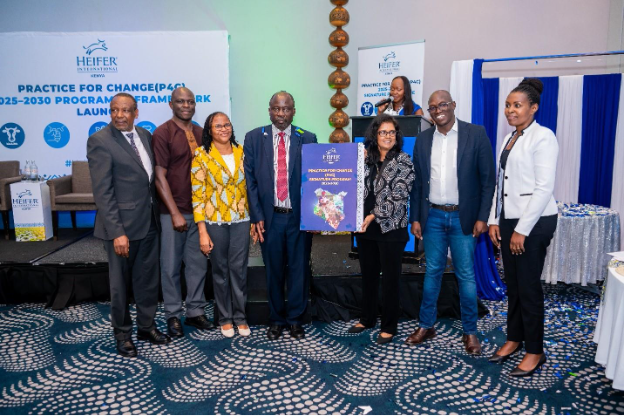
This April, a major milestone was achieved in Heifer International Kenya’s journey to transform agriculture for smallholder farmers: the official launch of the Practice for Change (P4C) Framework. The event brought together national policymakers, agripreneurs, academia, development leaders, and farmer-focused innovators under one shared vision: creating inclusive, resilient, and market-driven food systems.
The high-level event was graced by Surita Sandosham, President and CEO of Heifer International, alongside Dr. Chris Wanga, Director of Policy Research at the Ministry of Agriculture and Livestock Development, and Nelson Ndirangu, former WTO Ambassador.
Surita highlighted Heifer’s commitment to co-creating sustainable, locally led solutions that are informed by data and rooted in farmer realities. “This program is about transforming rural economies and helping farmers build sustainable livelihoods,” she stated.
The program was unveiled as a signature initiative to anchor Heifer International’s long-term impact in Kenya and across Africa.
The launch also spotlighted the contributions of youth innovators already implementing change through P4C:
Kevin Nyakaru, an avocado farmer, illustrated how access to export markets has significantly boosted profitability thus raising returns from $200 to $1,200 per tonne. With an acre yielding up to 16 tons annually, the goal is to strengthen the link between farmers and markets to maximize earnings for the small holder farmer.
Peninah Wanja, founder of Digicow, shared how AYuTe Challenge support enabled her platform to scale digital services to over 700,000 farmers monthly, with a new data lab underway in partnership with Animal Health and industry Training institute (AHITI) to make sure that the data provided is both actual and predictive, offering insights for current analysis and future planning.
Faith Kwamboka, founder of Desiccated Sweetness, detailed how value addition is creating employment and reducing post-harvest losses across rural Kenya.
Professor Daniel Mugendi, Vice Chancellor of Embu University, affirmed the academic sector’s role in shaping future agripreneurs. The university’s curriculum now integrates AI, entrepreneurship, and subsidized fees to make agriculture attractive to the youth.
The P4C framework will be implemented through a phased, data-driven approach in partnership with farmers, government, academic institutions, and the private sector. As outlined by Florence Kimata, Board Chairperson Heifer International Kenya, and Jahiel Oliver, founder of Hello Tractor, key focus areas include:
• Development of locally led sustainable value chains (starting with horticulture)
• Strengthened access to finance and technology
• Youth and women entrepreneurship support
• Cross-sector partnerships aligned to farmer outcomes
Jahiel emphasized that long-term engagement is vital. “It is not just about funding; it is about walking the full journey with the small holder farmer.”
The first half of 2025 has laid the groundwork for meaningful progress. With P4C now officially launched, Heifer International Kenya calls on all stakeholders to:
• Support youth use of Special Economic Zones (SEZs)
• Align policy and regulatory support with grassroots innovation
• Equip startups with financial and taxation expertise
• Walk alongside farmers from production to market
• Leverage technology to drive productivity and food security
• Build purpose-driven partnerships
• Promote farmer-centered data and decision-making
• Empower young people to lead in agriculture
As the year continues, the P4C Framework will serve as a foundation for Heifer International Kenya’s commitment to practical, inclusive, and scalable support for smallholder farmers. With the launch now complete, implementation moves forward anchored by farmers and driven by a clear vision for lasting impact.
In May, Heifer International Kenya convened a panel discussion titled “Youth Innovators, Private Sector Leaders, Financial Institutions and Development Partners.” at the FINAS 2025 Summit. The session brought together stakeholders across agriculture, finance, and development sectors to explore how youth can lead Africa’s agricultural transformation.
Opening the session, Clarice Bugo Kionge, Interim Country Director of Heifer International Kenya, stated, “Youth are not just the future but the present in shaping agriculture in Africa.” Her remarks set the tone for a conversation that focused on immediate youth inclusion and the role of agtech in advancing agribusiness.
Panelists highlighted persistent barriers discouraging youth from entering agriculture among them, limited access to finance, mentorship, and markets. Faith Kwamboka, CEO of Desiccated Sweetness and 2024 AYuTe Challenge winner noted that without collateral or credit history, many young people are unable to secure loans.
Representatives from ABSA Bank and the Agricultural Finance Corporation (AFC) shared their efforts to bridge these gaps. AFC reported financing over 1,000 youth in the past year, about 20% of its client base, through products aligned with farming cycles. ABSA bank emphasized that mentorship and business support must complement financial services.
The discussion also addressed the challenges faced by young women. Nana Amoah, Director of Gender, Youth and Inclusiveness at AGRA, spoke on how land ownership and capital access remain major hurdles. AGRA and Heifer International Kenya concurred that the AYuTe Challenge is indeed a model for inclusive support, that benefits youth innovators regardless of gender.
Mentorship was a recurring topic that was emphasized in the panel session. Tim Mwangi from Practical Action described a group-based approach that has reached over 100,000 youth in Western Kenya, supported by digital platforms that focused on value chain engagement. This model, he noted, is more sustainable than individual mentoring, and this enhances access to finance and markets.
Youth voices played a central role during the session. Penina Wanja, founder of Digicow Africa, shared how her agtech platform now supports over 700,000 farmers, enabled through partnerships with Heifer and the World Bank. Faith Kwamboka further echoed the need for better funding and market access for early-stage entrepreneurs.
During the Q&A, young participants asked for more flexible loan products, financial education, and support with product certification. ABSA Bank and Heifer International Kenya pledged to co-create solutions in response to these needs.
In closing, panelists called for integrated approaches that combine finance, mentorship, and training. Blended finance, mixing grants, loans, and equity were seen as critical for supporting youth led innovative ventures. Clarice Bugo Kionge noted that over 230 innovators have so far received more than $50,000 in grants through AYuTe, a testament to what targeted investment can achieve.
The session ended with a shared commitment to deepen collaboration, strengthen support systems, and ensure that youth are not just part of the future but actively equipped to shape the agricultural sphere in Africa.
Jehiel Oliver, Hello Tractor founder and CEO
Discover other ways Heifer International in Africa is making an impact in Kenya.
Did you know?
You can add multiple resources to this cart! Feel free to keep browsing, add more resources, and get all of your resources in one package. Easy!
Cart is empty
Success!
Please be patient while we send you to a confirmation page.
We are unable to process your request. Please try again, or view common solutions on our help page. You can also contact our Donor Services team at 855.9HUNGER (855.948.6437).
Success!
Please be patient while we send you to a confirmation page.
We are unable to process your request. Please try again, or view common solutions on our help page. You can also contact our Donor Services team at 855.9HUNGER (855.948.6437).
